Table of Contents
Colorado Forest Health Council Openings
There are currently two openings on Colorado Forest Health Council:
- Person who owns a ranch and owns grazing rights on public lands
- An enrolled member of a tribe that has a reservation within Colorado
If you fit the criteria for one of these openings, click here to apply to join the Colorado Forest Health Council.
Climate Adaptation Workshop
Speakers: Chris Swanston – Director of Science at Save the Redwoods League
Courtney Peterson – Colorado State University
Context
Brett Wolk (Associate Director, Colorado Forest Restoration Institute) set the scene for the workshop (see slides 1-7 of slides 1-7 of this presentation). Per its establishing legislation, the CFHC has climate adaptation written into its duties in a few different places. Examples:
- Two of the CFHC’s stated powers and duties include:
- “Monitoring trends related to forest ecosystem health, including those related to climate adaptation, and advising on opportunities for state-level action”
- “Development and support of solutions to manage and utilize woody material produced by mitigation work, including consideration of climate change and ecological impacts.”
- One member of the CFHC is someone who “is a forest scientist or is employed in a forest research position and has climate science expertise” (currently this spot is held by Eric Toman)
One of the recommendations in the CFHC’s 2023 Annual Report was, “The Legislative Committee asks CSFS to convene a forum or meeting around adaptive silviculture, Vapor Pressure Deficit changes, and how this impacts the future health of our forests and what measures for mitigation actions we should consider.” This Climate Adaptation Workshop was designed to fulfill this administrative recommendation.
Chris Swanston kicked off the workshop with an informational presentation about climate change. He shared more information than we can easily summarize in this blog post, but you can review his presentation slides here.
One slide that stood out in the CFHC discussion was titled “Adaptation is risk management” and described three ways to respond to climate change: resistance, resilience, and transition.
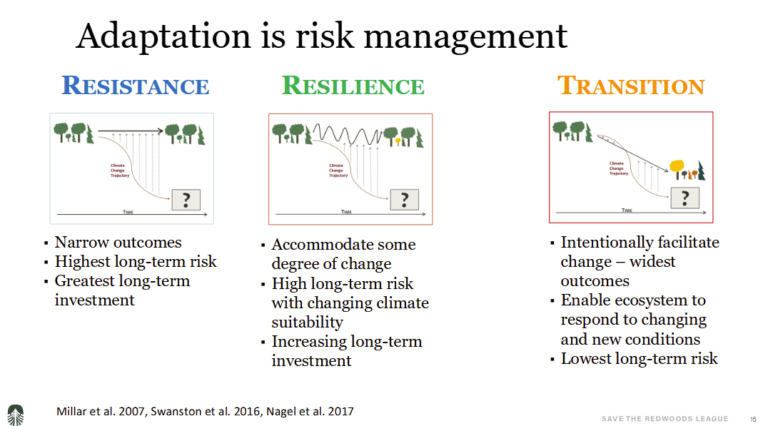
For more on this concept, read “Climate adaptation in practice: resistance, resilience, and transition” (Bucholz et. Al 2022).
Q&A
Q: If you put ‘no action’ in the concept drawn above (next to resistance, resilience, and transition), what would that look like?
A: ‘No action’ would be beyond transition. Under ‘transition,’ you’re intentionally facilitating change; if there were a ‘no action’ option, you’re accepting change however it comes.
Q: Looking at projections for vapor pressure deficit and temperature – do you have data that shows effect on wind conditions? Most fires are wind driven.
A: Chris didn’t specifically have data on this, but shared that, because wind is caused by differences in temperatures in a system, temperature changes are likely to change winds. Larimer County Commissioner Jody Shadduck-McNally added that Larimer County had ~19 red flag warnings in the first quarter of 2026, far more than the number in the first quarter of 2020, the year of the Cameron Peak Fire.
Q: How does biodiversity play into this?
A: Biodiversity often used synonymously with ‘resilience’. In a more diverse ecosystem, as things inevitably transition and change, you have more options for how to facilitate that change or what the resulting ecosystem might look like.
Q: There is a moral piece to climate change that we don’t usually talk about. For example, accepting loss. How do we talk about things that may be too far gone? Another example is talking about options. We’re trying keep as many options on the table as we can for current and future generations to be able to choose.
A: Chris refers in his presentation to ‘values’ – values inform risk tolerance. Most people think of values as monetary, aesthetic, recreational, etc. But in this case, it includes morals. For example: raking around individual redwood trees is purely a moral choice, as it is very costly. You can still choose resistance, but it’s costly and might not work. Every climate adaptation conversation is ultimately a morality conversation. Tip: approach with empathy.
Other Notable Events
Brett Wolk shared existing tools for adaptive management (see slides 8-19 of this presentation)
- Colorado Forest Health Council 30 year vision
- Colorado Forest Resilience Planning Guide
- Colorado Forest Tracker
- Colorado Forest Action Plan
Amanda West Fordham (Associate Director, Science and Data Division, Colorado State Forest Service) gave an overview of the Colorado Forest Action Plan and components of climate adaptation in this.
- In 2019, there was a Forest Action Plan climate adaptation workshop using Northern Institute of Applied Climate Science Climate Adaptation Workbook
- Examples of the Forest Action Plan informing legislation
- HB 22-1012 Wildfire Mitigation and Recovery
- SB23-005 Forestry and Wildfire Mitigation Workforce
- Many other state/local plans have integrated the Forest Action Plan
- Setting stage for how the Forest Action Plan aligns with the CFHC’s 30 year vision (read this summary)
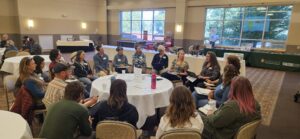
Courtney Peterson (Program Manager, Adaptive Silviculture for Climate Change Network) led us into the interactive portion of the workshop. First, we took themes from the CFHC 30 Year Vision, and roughly combined them with strategies/actions from FAP. For each strategy, CFHC members were asked to list barriers and possible solutions to barriers on sticky notes. Click through each tab below to see what we came up with:
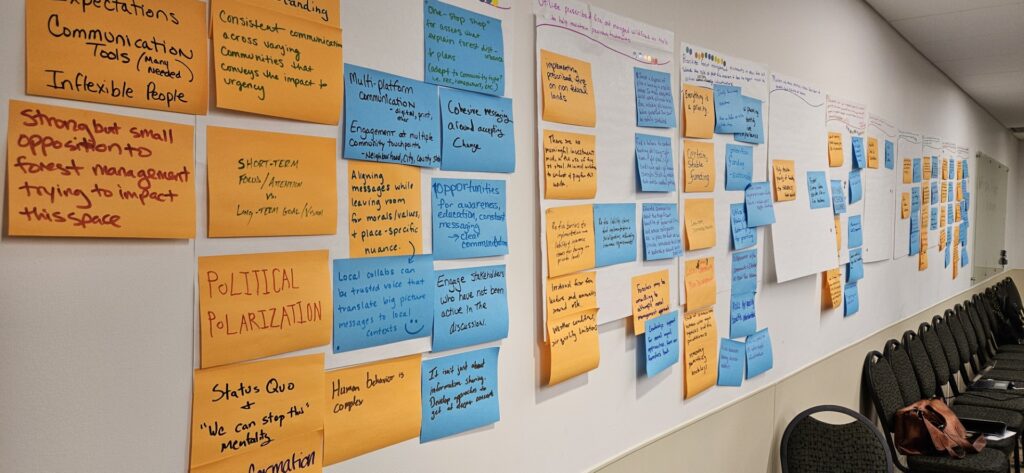
Realign community expectations before, during, and after a forest disturbance, and plan for post-disturbance recovery and transition:
- Expectations, communication tools (many needed), inflexible people
- Strong but small opposition to forest management trying to impact this space
- Consistent, shared language or understanding
- Consistent communication across varying communities that conveys the impact to urgency
- Short-term focus/attention vs long-term goals/visions
- Political polarization
- Status quo and “We can stop this” mentality
- Misinformation and lacking understanding of data
- Multi-platform communication (digital, print, other), engagement at multiple community touchpoints (neighborhood, city, county, state)
- Aligning messages while leaving room for morals/values, and place-specific nuance
- Local collabs can be trusted voice that translates big picture messages to local contacts
- Human behavior is complex
- “One-step shop” for assets that explain forest disturbance, less plans (adapt to community type? e rec, homeowners, etc.)
- Cohesive messaging around accepting change
- Increase opportunities for awareness, education, constant messaging -> Clear communication
- Engage stakeholders who have not been active in the discussion
- It isn’t just about information sharing. Develop approaches to get at deeoer concept
Total Sticky Dots: 24
Utilize prescribed fire and managed wildfires as tools to help maintain previous treatments:
- Implementing prescribed fire on non-federal lands
- There are no meaningful investments made in the use of fire as a tool. Minimal workforce to conduct and pay for this work
- Prescribed fire barriers to implementation -> Liability and insurance issues for burning on private lands
- Irrational fear from leaders and communities around risk
- Weather conditions, quality limitations
- Prescribed fire liability claims fund implementation and socialization; alleviating insurance requirements
- Invest in disposal of piles and burning in a realistic manner. In many cases, mechanical work will need to be done, including pile burning, before prescribed fire can be safely conducted
- Find a balance to conduct burning utilizing right time, right place, right conditions, and right resource concepts. Staffing models that watch weather patterns
- Educate communities about the significant benefits of prescribed fire and ensure safeguards are in place so that we can provide assurance to citizens and leadership around best practices
- Foresters may be unwilling to attempt novel management approach
- Leadership support for novel management approaches. Have our foresters’ back
Total Sticky Dots: 6
Prioritize forest management treatments in areas that will reduce the risk of post-fire erosion and have the biggest impact on critical utility infrastructure:
- Everything is a priority
- Certain, stable funding
- Long-term sustainable funding
- Local control community plan development
- Lack of communication between water managementagencies and fire practitioners
- Removing permitting backlogs
- Identify transitional ecosystems, areas we decide not to fight climate change
- Local planning, identify adaptive importance
- Prioritize funding – sustainable
- Increase comms, adjust priority areas and funding, focus – include water supply infrastructure
- Utilize weather, ready water data – program for prioritizing
- Collaboration w/ the community and elected to create real solutions
- Make water quality benefits understandable
- Raise awareness among decision makers
- Prioritize protection of water supply infrastructure
Total Sticky Dots: 12
Maintain and, where practical, increase forest cover to promote forest retention and creation:
- High elevation paucity of knowledge, esp snowpack/forest tradeoffs
- Forest diverse values outside fire and fire resistance
Total Sticky Dots: 1
Collaborate with land management agencies, fire protection districts, place-based collaboratives, insurance organizations, and local government to promote fire-adapted concepts that lead to reduction of risk to communities and utilities:
- Lack of capacity, staff resources, time (for all participants)
- HOA/County mitigation requirements
- Continued expansion of WUI
- Number and diversity of organizations involved with limited overarching coordination
- Lack of urgency when compared to the risk, false assumptions that communities are better protected than they are
- Adapt the fire adapted communities framework (national)
- Aerial support/plans at the county level
- Moratorium on WUI expansion?
- Consider models for higher level coordination
- Increase capacity funding, fill gaps of regional coordination
Total Sticky Dots: 18
Consider reforestation with species mixes better suited to expected forest conditions:
- Available seed for reforestation
- Fund cone collection
Total Sticky Dota: 4
Identify locations where pre-treatments, such as thinning, support the use of prescribed or managed fire:
- Similar to #2, lack of resources (workforce, funding, etc.) and inconsistent messaging
- Data collection inefficiencies
- Widespread use of forest tracker
- Fund next gen technology to better monitor
- FHAC + CFC collab to develop plan to address cohesive strategy w/ investments
- Appropriate investments
Total Sticky Dots: 2
Monitor for forest trajectories and social response to treatments and harvesting, natural disturbance, and climate change to promote adaptive ecosystem management:
- Monitor to perform adaptive management, funding and incentives are focused on project implementation not monitoring and adaptation
- Acceptance that we can’t effectively adapt if we don’t create and sustain feedback loop -> Money
- Capacity to monitor -> And flexibility/social license to learn from/adapt to failures
- Agency capacity and embrace of adaptive management
- Moving prediction to action
- Monitoring and adaptive management, build expecations for monitoring into agency accountability, as well as grant funding. Incentivize adaptive approaches
- Learning as an organizational goal
- Place greater emphasis on application/experimental approaches
Total Sticky Dots: 20
Support a wood products industry to harvest stored carbon and promote regeneration for future carbon storage and sequestration:
- Limited existing industry and substantial capital needed to rebuild and maintain industry
- Barriers for wood products industries: Lack of consistant supply and welcome from activities
- Hung up on carbon and thoughts that it can save us
- Lack of awareness about new technologies and emerging natural resource management
- Align investments with values to capture externalities and future loss to provide resources for investment
- Create a consistent product offering program
- Lack of acceptance that our success will be about both restraint and action -> Benefits from utilizatoin
- Recognize carbon reality and shift from increased carbon to increased persistance
- Biochar! Pathways, incentives, education, and opportunities
Total Sticky Dots: 10
Align financial and technical resources to suggest includsive, science-informed collaboration that leads to forest resilience management actions:
- Lack of resources at state level to fund such forest management actions
- Federal funding and agreement/contracting processes
- Lack of clarity/consistency on available resources (funding/education/technical assistance) for wood products industry
- Current funding is 1. Not enough (by a long shot), 2. Not “flexible”, 3. Episodic
- We speak of cohesive strategy, but we do not routinely get in cohesive strategy. Fueled treatment alone will not help us “live with fire
- Finite financial resources; lack of resources at state level to fund such forest management actions
- Community hub showcasing funding/education/tech assistant and options for stacking/match/points of contact etc. (public and private)
- Raise awareness among elected leaders of risk to communities, shift budget priorities, work w/ local governments that have resources
- Raise awareness among elected leaders around the tremendous risk to their communities, shift budget priorities, work with local governments that have resources to partner
- Use Forest Resilience Planning Guide to align resources and need money
- Prioritize and fund the most effective solutions
- Create additional plans/frameworks -> Water plan “outdoor strategy” USPS/BLM MON’s DNR
- Need: Lot more money, sustained over time, more flexible
- Plan to implement all 3 legs of cohesive strategy
Total sticky dots: 12
Here were some key discussion points as we reflected on the activity:
- Local scale matters!
- No action is not an option, but we can prioritize where the actions are
- Public attitudes are a major concern – research shows that education/information-sharing is not always going to impact peoples’ actions/attitudes. Underlying morals impact actions/attitudes more than new information.
- There are competing priorities across the board. How do we move beyond just speaking about competing priorities, and actually take action?
- Common theme: lack of capacity. This feeds back into priorities, and is reflective of public attitudes. Every discussion about climate change is a discussion about values and what people care about.
- We speak carefully because we don’t want pushback. Can we speak plainly instead?
- Every community is different. Need to collaborate at the local level, rather than top-down. Embrace the unique things that each community is doing. ‘We will be effective differently’.
We added sticky dots to vote on which topics we wanted to address in depth at this meeting. Once we identified the group’s top-rated priority (“realign community expectations before, during, and after a forest disturbance and plan for post-disturbance recovery and transition”), we split into breakout groups to discuss in greater depth:
- How do we enact policy in CO to support bringing these ideas into action to positively influence forest health in CO? (think: what are the low hanging fruit?)
- Where is policy most likely to change outcomes on the ground? Actually make a difference
Breakout group report-outs:
Group 3 ideas:
- Enhancements to, and broader outreach around, Live Wildfire Ready campaign
- Integrate with CWPPs
- Nuanced conversation & emphasis on local control/local values
- Think: How do communities want to receive information? Consider different preferences and different access specific to communities.
Group 2 ideas:
- Be realistic & transparent about the cost of all these ideas.
- Dan Gibbs suggested modeling a campaign after the 2007 Colorado Transportation Finance and Implementation Panel. This group convened regional meetings with hundreds of folks statewide to generate recommendations for transportation in Colorado. Because the group was created by the Governor, it came with some immediate credibility and support from the top. This, combined with the fact that hundreds of local representatives were involved in creating recommendations, led to legislative support.
- Importance of support from the top (a political champion), paired with local solutions.
Group 1 ideas:
- Importance of differences in counties, their values, and their economies (example: some counties have lots of tourists, who may not know as much about Colorado ecosystems compared to those who live here)
- Also noting different levels of public trust among federal, state, and county officials, collaboratives, etc.
Other discussion:
- Some disturbances happen quickly (wildfire), others happen over medium term (pine beetle) or longer term (vapor pressure deficit, chronic stress, climate change). The ways we talk about, educate on, budget for, and react to these are different. This complicates communication.
- Most progress happens via personal connection. It’s hard to hate someone you’ve had coffee with.
- Need for consistent big picture messaging, adapted to local level.
Federal Updates
The US Forest Service is undergoing a significant reorganization. More information can be found here: https://www.fs.usda.gov/about-agency/reorganization
State Policy Updates
These updates were current at the time of the meeting – for current updates, click the hyperlinks connected to each bill number.
- HB 26-1184 – Sunset Process Forest Health Council. The CFHC is set to sunset in September 2026; this bill would extend the CFHC until 2033.
- HB 26-1205 – Colorado State Forest Service Good Neighbor Authority. This bill originated from a CFHC recommendation and would expand Good Neighbor Authority for CSFS. The bill passed the House and Senate and is likely to be signed very soon.
- HB 26-1213 – Sunset Biomass Utilization Grant Program. This bill would sunset the CSFS Biomass Utilization Grant Program this year. The bill passed the House.
- HB 26-1289 – Modification of Certain Tax Expenditures. Two key changes here include:
- Section 8 modifies income tax credit for wildfire hazard mitigation expenses to include thinning of woody vegetation that is at risk of or has been killed by mountain pine beetles or spruce beetles.
- Section 19 reinstates sales and use tax exemption for wood from salvaged trees killed or infested by mountain pine beetles or spruce beetles (this provision would otherwise expire in June 2026).
- HB 26-1331 – Modify 2026 Interim Committees. Reduces the amount of recommendations that a committee can put forth from 5 to 3. This is relevant to the Wildfire Matters Review Committee, which the CFHC reports to.
- HB 26-089 – Recreate Wildfire Matters Interim Committee. The committee was repealed in September 2025.
- HB 26-1132 – Practices to Support Pollinators. The CFHC has been tracking this bill for a while.
Legislative Committee Update
The Legislative Committee unanimously recommended moving 5 recommendations forward for full CFHC review and approval. The full CFHC then voted to approve the recommendations.
You can read the 5 Legislative Committee recommendations HERE.
Additionally, the committee is working on compiling resources about funding and technical assistance. This will begin with a one-pager and QR code, but eventually could become a hub. An initial one-pager will be available in the next few CFHC meetings.
There was also discussion about a letter from the CFHC to federal representatives, regarding concerns, needs, and things the CFHC wants to see continue at the federal level (example: ensuring seasonal wildfire and recreation jobs are still available this year). The specifics of this letter are under consideration, and will be discussed further at a future CFHC meeting.
Leveraging Resources Committee Update
We shared a handout summarizing the committee’s progress over the past year or so. The committee doesn’t have legislative or administrative recommendations at this time, but the one-pager outlines work we have done and next steps that we see fit for the CFHC to pursue further. The idea for these recommendations is that there would be subject matter-specific committees set up to dive deep into each one, rather than the Leveraging Resources Committee trying to tackle them all.
Review the Leveraging Resources Committee one-pager HERE.
Colorado Fire Commission's Prescribed Fire and Forest Improvement District Subcommittee Updates
Prescribed Fire Subcommittee is working on an implementation plan for the Prescribed Fire Statewide Strategy.
The Forest Improvement District (FID) subcommittee has been continuing to explore the legal context of FIDs and develop recommendations to make this a more usable tool in the toolkit for communities in Colorado to do forest health and wildfire mitigation work. For more information on FIDs, check out the CFCN’s recent Branching Out on FIDs.
Contact Katie Lobodzinski (Colorado Fire Commission administrator) if you are interested in attending a Colorado Fire Commission meeting (open to the public) and/or joining a subcommittee.
Mountain Pine Beetle Update
The Mountain Pine Beetle Task Force had their first in-person meeting on April 1st. In the meeting, Task Force members worked on setting priorities and understanding agreements. Some key themes that arose from the meeting included:
- Communication strategy for the Task Force and about mountain pine beetle generally
- Focus on short term recommendations first (with medium and long term recommendations happening later on)
- Focus on how to support landowners
The Task Force agreed to get the ball rolling with three formal committees (official names TBD):
- Communication committee
- Local engagement committee
- Science committee
Agency Updates
Colorado State Forest Service
Update from Director / State Forester Matt McCombs
- Organizational updates: Colorado State University, which houses CSFS, is doing a restructuring. CSFS is moving from Warner College of Natural Resources to the Office of Engagement and Extension. They will maintain offices around the state as usual. They are excited to integrate more with Extension partners. Roots at Warner College are strong, so partnerships there will continue. This will officially happen July 1. Read the CSU announcement here.
- Working on strengthening partnerships with NRCS.
- Nursery is in its final phases – almost complete!
Division of Fire Prevention and Control
Update from Director Mike Morgan
- Regarding the proposed unification of federal firefighting – we see opportunities to strengthen already strong relationships with federal partners.
- Multi-mission aircraft has flown 42 missions this year. Delivered 120,000 gallons of water so far in 2026.
- Figuring out what are immediate needs related to Mountain Pine Beetle (new and existing). What should we be doing better, more efficiently, more effectively?
- Wildfire preparedness plan – public briefing with the Governor coming up on April 30th.
- 5 acre Cougar Run Fire in Larimer County is under investigation – it may have been caused by an air curtain burner doing fire mitigation work. It’s very important to figure out what happened and learn from it so that it doesn’t happen again with any of the other air curtain burners in the state.
Department of Natural Resources
Update from Director Dan Gibbs
- COSWAP did its largest workforce development grant release ever at the end of 2025. There were more than $13 million in asks. Program funded around $7 million. Program will release 5th round of landscape resilience investments this fall.
- Governor Polis reactivated the drought task force for the first time since 2020. Colorado has experienced its warmest year in 131 year history of tracking temps. Driest on record.
Roundtable Update
Katie McNovak, Coordinator of the Colorado Forest Collaboratives Network
Serving on the CFHC as “a member who is employed or associated with a forest collaborative organization”
- Upcoming event: 2-part Branching Out series on communicating with funders
- Part 1: Communicating Impact (hearing from collaboratives)
Thursday, April 30th 12:30 – 2:00pm
Full description & register here - Part 2: How impact resonates (hearing from public and private sector funders)
Tuesday, May 26th, 12:00 – 1:30pm
Full description & register here
- Part 1: Communicating Impact (hearing from collaboratives)
Samantha Albert, Deputy Director of the Colorado Outdoor Recreation Industry Office
Serving on the CFHC as “an employee of the Colorado Office of Economic Development with a leadership role and expertise in outdoor recreation”
- Webinar last week on impacts of recreation
- Second series coming soon, outdoor rec/outfitters industry
Archuleta County Commissioner Veronica Medina
Serving on the CFHC as “a county commissioner west of the continental divide”
- In Archuleta County, they have been talking about being proactive rather than reactive. In May, there will be a community meeting to share what “go bags” look like, what to pack, notes to leave on door, and other ways to be proactive in case of an evacuation.
- The county is trying to create website like VIPR (Virtual Incident Procurement). People offer up resources that they have to offer in case of an emergency; others can access it and find the resources they need. Hitting some roadblocks, but hope to have it up soon.
John Ring, Forestry Program Lead, US Bureau of Land Management
Serving on the CFHC as an agency representative
- BLM is short staffed.
- Putting out timber sales this month, each around 1 million board feet.
- Currently have partnerships with CSFS, Mule Deer Foundation, and others.
Larimer County Commissioner Jody Shadduck-McNally
Serving on the CFHC as “a county commissioner east of the continental divide”
- There was an incident a couple days ago in Larimer County.
- Website now available with data informing decisions on fire restrictions, featuring zones. There have been far more red flag warnings in Larimer County so far in 2026 than at the same time in 2020, which was the year of the Cameron Peak Fire.
Amy Moyer, Director of Strategic Partnerships, Colorado River District
Serving on the CFHC as “an individual employed by a water supplier, including a municipal drinking water supplier and an irrigation water supplier, west of the continental divide”
- A topic we’ve talked about bringing to council is lessons learned from the Elk and Lee fires in Rio Blanco County. These are an example of how fires can impact the agriculture industry.
Patt Dorsey, Director of Conservation Operations, Mountain West, National Wild Turkey Federation
Serving on the CFHC as “an individual employed by or associated with a wildlife organization”
- An agreement NWTF and NRCS ended nationally resulting in loss of employment for 30 foresters across the country, including two in Colorado.
Douglas County Commissioner Abe Laydon
Serving on the CFHC as “a county commissioner east of the continental divide”
- County formally adopted budget item to have year-round aerial firefighting support in climate controlled hangar.
- Launching the first county owned and operated biochar facility in the country.
- Had a successful prescribed fire that went well.
- Updated emergency alert system.
- Using AI for wildfire detection.
Brett Wolk, Assistant Director, Colorado Forest Restoration Institute
Serving on the CFHC as “an individual employed by a research institution and who has forest policy expertise”
- Beautiful hard copies of the Colorado Forest Resilience Planning Guide are now available!
Forest Health Council Committee Structure Discussion (Continued from Last Meeting)
This topic not summarized because it is not relevant to the Colorado Forest Collaboratives Network.
Upcoming Meetings
The next meeting of the Colorado Forest Health Council will be on either August 26th or 27th. There is also a a meeting of the CFHC being planned for November.