What Colorado Collaboratives want the Colorado Ponderosa Mountain Pine Beetle Task Force to Know
Blog post by Katie McNovak, Colorado Forest Collaboratives Network Coordinator
Formatted by Bianca Anderson, Colorado Forest Collaboratives Network Assistant
Background & Audience
In February 2026, the Colorado Forest Collaboratives Network (CFCN) hosted a Branching Out session on the Ponderosa Mountain Pine Beetle Task Force (herein, the Task Force). After a panel presentation from the Task Force co-chairs (Department of Natural Resources Director Dan Gibbs, Colorado State Forest Service Director Matt McCombs, and Division of Fire Prevention and Control Director Mike Morgan), attendees on the call moved into breakout groups to discuss these three questions:
- Flash forward 3 years from now, what will the Ponderosa Mountain Pine Beetle Task Force have accomplished that makes you say “that was a successful initiative”?
- How can the Task Force effectively engage with, and ultimately impact, local collaboratives?
- The Executive Order establishing the Task Force mentions that the Task Force shall, “Coordinate and collaborate across the governmental sector to support the maximum effectiveness and efficiency of state, local, and federal resources, incentives, and processes.” What needs to happen in the next ~3 years for state & federal agencies, alongside local collaboratives, to reach this maximum effectiveness and efficiency?
The Branching Out session was targeted toward folks involved in place-based forest collaboratives across Colorado. We had nearly 50 people in attendance, including employees of community-based organizations, non-profits, state agencies, utility companies, the wood products industry, and more, most engaged in at least one collaborative in Colorado.
What Collaboratives Want the Task Force to Know
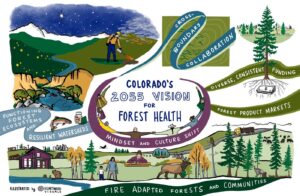
Note: As we compiled notes from the session, we noticed that a few common recommendations emerged across all three discussion questions. Throughout the recommendations, we note where ideas from the session closely aligned with the themes from the Colorado Forest Health Council’s 30-Year Vision for Forest Health.
This Task Force has an opportunity to change the bigger picture strategy for forest health in Colorado – it’s not just about beetles. (This point aligns with the 30 Year Vision theme “Functioning forest ecosystems & resilient watersheds”)
Attendees on the call talked about looking beyond just this pine beetle outbreak to integrate the following into a long-term, bigger-picture vision:
- Wildfire mitigation, response, and recovery
- Healthy, resilient forests
- Funding and capacity needs for forest management
- Forest treatments are treated as ‘infrastructure’ (ongoing over time with regular maintenance, rather than treated as a one-time project)
- Forest management across jurisdictional boundaries
- Forest products industry and workforce development
Partners across sectors and scales need to have honest conversations to identify each party’s strengths and limitations, and work seamlessly toward a shared vision.
To move quickly and efficiently from planning to action, the Task Force should focus on coordinating and enabling existing strategies rather than starting from scratch. Many plans already exist, from statewide strategies to community plans. Rather than create something totally new, the Task Force should help connect these and identify and remove barriers to implementation. The Task Force can also identify strategies that haven’t worked in the past, and share lessons learned and recommendations for improvements.
The Task Force should engage meaningfully with collaboratives; collaboratives can help the Task Force build trust in communities, facilitate more effective and efficient resource sharing, build on existing efforts, and strategize at multiple scales. (This point aligns with the 30 Year Vision theme “Cross-boundary collaboration”) To build trust with collaboratives, the Task Force should offer opportunities for meaningful engagement and two-way discussion with collaboratives, and share information about how and why decisions are made. It is important to have reciprocal conversations, rather than only asking for one-way input on decisions. The Task Force should set expectations for engagement with collaboratives to ensure everyone is aligned early on.
The outbreak / Task Force presents an important opportunity for improving and amplifying public messaging, especially about forest ecosystems and the role of the forest products industry in achieving forest health outcomes. (This point aligns with the 30 Year Vision theme “Mindset and culture shift”) As the Task Force works toward more holistic forest stewardship in Colorado, there are lots of learning opportunities for Colorado’s public. The Task Force can help unify messaging around forest health, beetles, wildfire, management practices, the forest products industry, and more.
Attendees recommended designating a communications expert to help with a unified messaging campaign. Tips for messaging include:
- Messaging should be unified, yet nuanced. Collaboratives should be involved in developing communications as they can help scale big-picture information down to local and regional contexts.
- Information should include how the forest products industry supports forest health, economies, and sustainable wood products.
- Targeted messages should help private landowners understand their role in forest health and what they can do to be a part of the solution.
- Avoid overusing fear-based messaging
Private landowners need to be a part of the solution – education around what they can do, and programs to help them get there, are an important piece of the puzzle (this point aligns with the 30 Year Vision theme “Fire-adapted forests and communities”). The Task Force should expand funding opportunities for projects on private lands and create targeted messaging to help landowners understand how they can help be a part of the solution.
Other specific ideas/recommendations:
- Can the Task Force inform aspects of the new US Wildfire Service as it forms?
- Learn from successes and failures in other places – other states and even other countries.
- Look for opportunities to create jobs in rural area