In this summary…
Page 1: Introduction and Wednesday Activities
- Our theme: What does “Collabor-Action” mean?
- Wednesday, September 9th
- Training: Taking Action with the Forest Resilience Planning Guide
- Avista Fire Resilience Challenge
- Welcome Social
Page 2: Thursday Summit: Morning sessions (you are here!)
- Land Acknowledgement & agenda roadmap
- Colorado Cafe: Table discussions & case studies that align with the 30-Year Vision for Forest Health in Colorado
Page 3: Thursday Summit: Afternoon sessions
- From planning to action: Understanding collaborative readiness through the Upper Gunnison Shared Stewardship Council
- Leadership panel
Thursday, September 10th: Forest Health at the Speed of ‘Collabor-Action’
Land Acknowledgement & Welcome to Western Colorado University
Speaker: Leslie Taylor, Vice President, Marketing and Enrollment, Western Colorado University
Leslie Taylor, Vice President for Marketing and Enrollment at Western Colorado University, opened the day by recognizing the history of the land we gathered on, where Western Colorado University now sits. Below is the official WCU land acknowledgement:
Indigenous peoples have lived, prayed, loved, laughed and raised children in the Gunnison and Uncompahgre country. The Utes and their many distinct bands are primary among many groups who historically had ties to this land. Western Colorado University humbly acknowledges the sacred sites, hunting and gathering grounds, spiritually important mountains, botanical resources, special buttes and other places of significance for the Indigenous peoples. Members of the Western community hereby express respect for the Utes and their ongoing connections to this land.
You can learn more about the WCU land acknowledgement HERE.
Agenda roadmap and framing the day
Speaker: Katie McNovak, Coordinator of the Colorado Forest Collaboratives Network
CFCN Coordinator Katie McNovak kicked off the day by framing up the theme of Summit, Forest Health at the Speed of “Collabor-Action” (see introduction above), and laying out the agenda for the day. A full PDF agenda is available HERE.
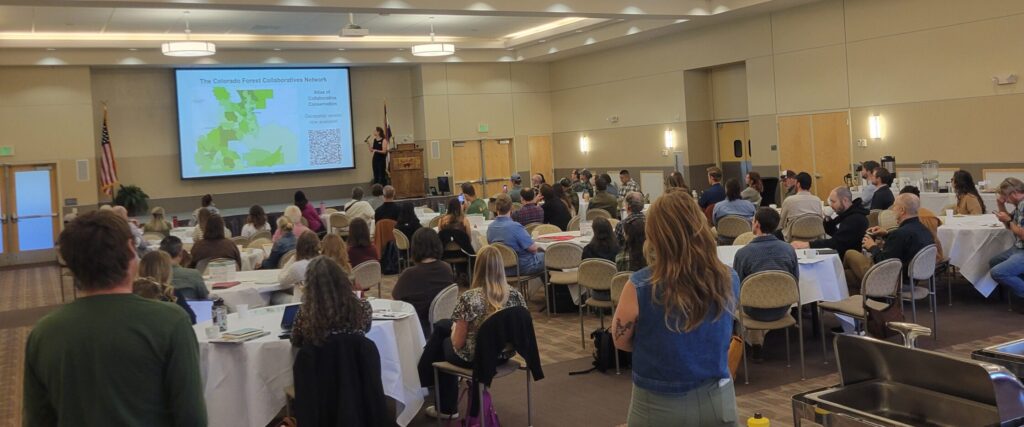
Colorado Cafe: Table discussions and case studies that align with the 30-Year Vision for Forest Health in Colorado
Featuring an introduction by:
- Rebecca Samulski, Executive Director, Fire Adapted Colorado
- Courtney Young, Forest Health & Wildfire Mitigation Program Administrator, Colorado Department of Natural Resources
Did you know? The CFHC consists of 26 members, several of which were at Summit! A list of current CFHC members and their roles can be found on pages 5-8 of the CFHC 2025 Annual Report.
What is the Colorado Forest Health Council (CFHC)?
From the CFHC website: The CFHC is a volunteer stakeholder body whose role is to provide a collaborative forum to advise the Governor, through the Executive Director of the Department of Natural Resources, and the Colorado General Assembly, on issues, opportunities, and threats to Colorado’s forests.
Creating Colorado’s 30-Year Vision for Forest Health
One of the CFHC’s statutory duties is, “Development of, and recommendations for, attaining a thirty-year vision for forest health in Colorado, including developing goals and both annual and multi-year recommendations for actions to improve forest health and reduce fire risk through increased funding and capacity building.” In 2025, the CFHC set about creating that vision. Fire Adapted Colorado was hired to facilitate the development of the 30 Year Vision.
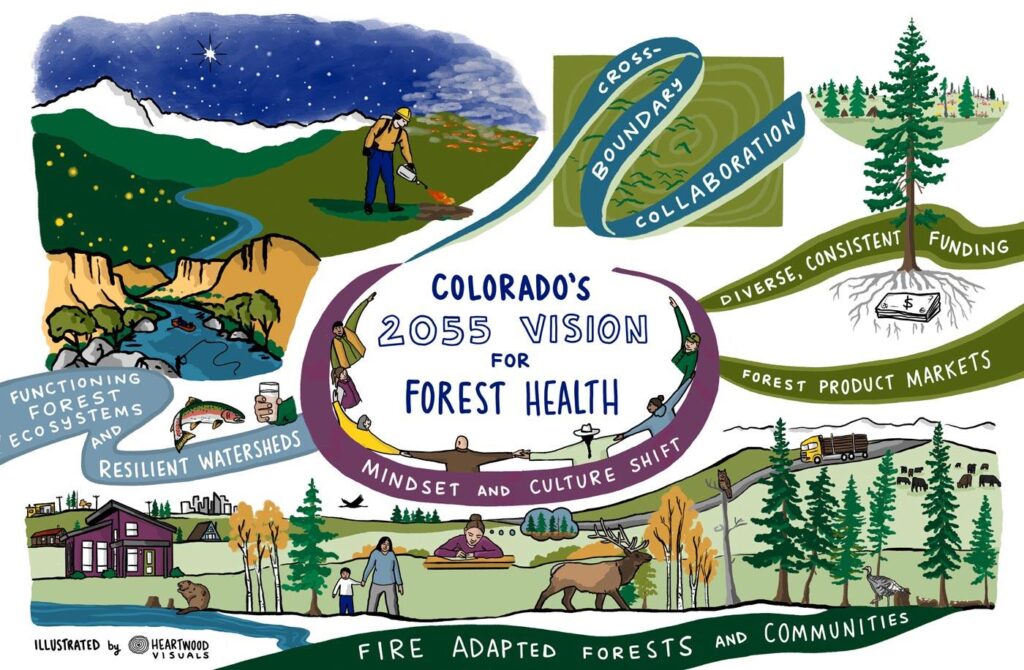
Want your own 30-Year Vision poster to display? Posters are available at the following CSFS field offices, while supplies last: Fort Collins, Durango, Montrose, Grand Junction, Granby, Rifle, Steamboat, Cañon City, Salida, La Veta.
The process for developing the vision included:
- An initial survey of CFHC members
- Draft vision created in fall 2024
- Public feedback period
- Review of existing strategic planning documents guiding work in Colorado
- Developing Goals & Actions to work toward each of the vision buckets
- A CFCN-hosted Branching Out session soliciting input on the “Cross-Boundary Collaboration” bucket of the vision
- Incorporation of additional subject matter expertise
Using the 30-Year Vision
The CFHC is using the Vision to guide their work and priorities. It was a key part of the CFHC’s 2026 legislative breakfast, and helps guide the development of new CFHC legislative priorities. In 2027, the CFHC Legislative Committee is recommending that the Vision be formally adopted by the state legislature.
Table Discussions
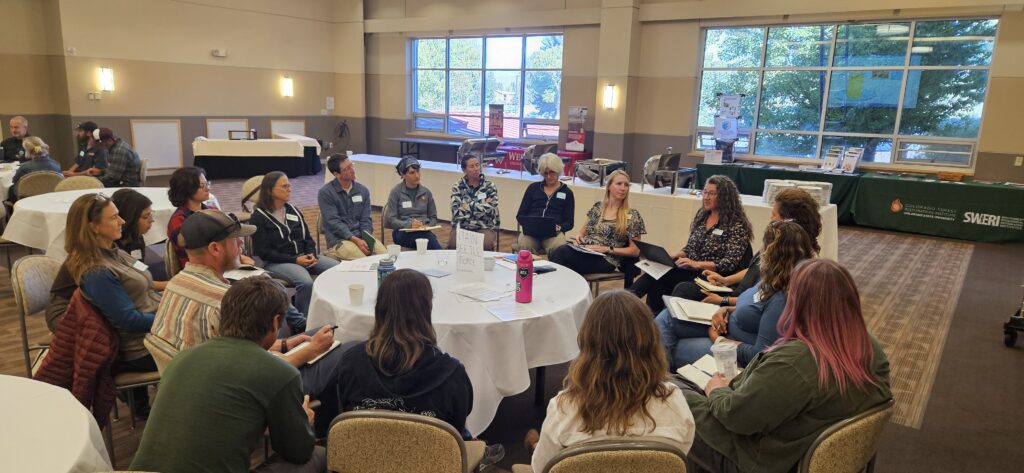
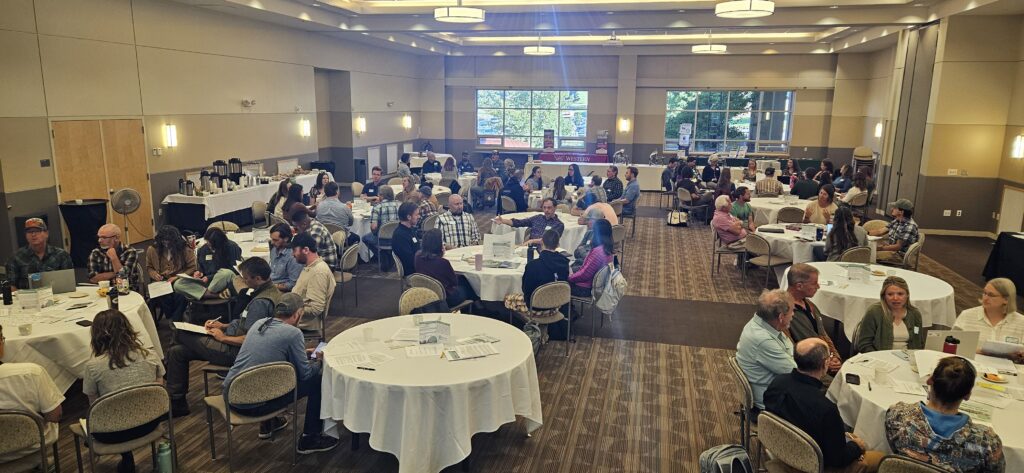
We know that the 30-Year Vision is already in progress; countless individuals and organizations are moving the needle on the Vision themes every day through work in their communities. To learn more about how the 30-Year Vision is coming to life, we spent the remainder of the morning in concurrent ‘world cafe’ style table sessions. Each table topic provided real life examples and discussions connected to one or more of the themes from the 30 Year Vision. Read the tabs below for a recap of each table discussion.
Facilitated by:
- Christina Burri, Deputy State Forester, Colorado State Forest Service
- Alison Lerch, Assistant Director, Forest Health and Wildfire Mitigation, Colorado Department of Natural Resources
About the Ponderosa Mountain Pine Beetle Task Force
In December 2025, Governor Polis signed an Executive Order establishing the Ponderosa Mountain Pine Beetle Task Force in response to the ongoing mountain pine beetle outbreak along the Colorado Front Range. The Task Force consists of 30 appointed and ex officio members, and is charged with 15 tasks covering a broad range of forest health topics from fire suppression strategies to reforestation and more.
The Task Force has 6 working groups leading the development of recommendations:
- Science and Research Working Group
- Local Engagement & Public Communications Working Group
- Fire and Risk Management Working Group
- Forest Health and Watersheds Working Group
- Industry and Workforce Working Group
- Policy and Funding Working Group
Here are a few key points from table discussions:
Comment: Communication piece is extremely important. People need information.
Note: The Task Force has been focusing heavily on communication. The Colorado State Forest Service has also been focusing heavily on communication. Here are some resources currently available and cross-posted on the MPB Task Force webpage that you can feel free to share:
- Colorado State Forest Service MPB Webpage
- County-specific resources:
Question/concern: Are the recommendations practical and tactical? Or are they very broad and high level?
Answer: The draft recommendations were still fairly high level as of the time of Summit. The Task Force is adding action-oriented detail as they continue to develop the recommendations.
Comment: There is not much opportunity for non-Task Force practitioners to provide input on recommendations.
Answer: Two ways that folks can provide input are through public comment, or by getting in touch directly with working group members.
Follow-ups:
- RESOURCE: September 2026 Draft Recommendations. Note: These recommendations are DRAFT as of time of writing; the Task Force expects to finalize these by the end of 2026.
- NOTE: Hearing a desire for CFCN participants to be more looped in with MPB Task Force activities, we will work on sending more MPB Task Force related information (such as meeting dates/times, draft recommendations, and other important updates) through the CFCN email listserv. Additionally, remember that all MPB Task Force meetings are open to the public, and there is an opportunity for public comment at the end of each Task Force meeting. You can find upcoming meeting dates and links to join the meetings on the MPB Task Force webpage.
Facilitated by Tim Pinnow, Chief Executive Officer, West Region Wildfire Council
In 2025, Tim Pinnow was hired as the Chief Executive Officer of West Region Wildfire Council (WRWC). The mission of West Region Wildfire Council (WRWC) is “Building wildfire resilient communities in Western Colorado.” Tim kicked off each round of discussions with some background about the WRWC and how it has changed over time, using examples and insights gained from WRWC’s nearly 20 years of work. He shared how he has hit the ground running in his role as CEO, launching new fundraising efforts and identifying new board members. Tim also shared how he keeps long-term planning front of mind, especially as many non-profits have shifted away from reliance on federal funding.
Some key points included:
- 0% interest revolving loans – he shared that many non-profits shy away from these because even 0-interest debt can be scary, but if used correctly can be a valuable tool for small organizations.
- Considerations in a board of directors – a few types of representation on the WRWC include a lawyer, philanthropist, marketing expert, and emergency manager.
- WRWC hired a consultant to conduct a ‘wealth screen’ to identify potential donors in the community and their capacity to give.
- When sharing a position between multiple organizations, it is easy for the position description to balloon into something unrealistic. It is important to set very clear roles and manage expectations.
- As collaboratives develop and reach later stages of readiness, it becomes important to know what to say “no” to. It is important to get clear about what does and doesn’t suit your collaborative’s role.
Recommended follow-ups:
- RESOURCES: Want to learn more about collaborative governance? Check out the CFCN’s presentation on Creating and Revising Governance Documents (video, 48 minutes), and Action 3 of the Colorado Forest Resilience Planning Guide (pg. 27-33)
Facilitated by Rebecca Dannels (GIS Specialist, Colorado State Forest Service) and Phoebe Bauer (GIS Analyst, Colorado State Forest Service)
At this table, participants explored the question: How can collaborative mapping strengthen cross-boundary collaboration and support coordinated action?
The table facilitators started off setting some context:
- What is collaborative mapping? Collaborative mapping is a participatory process where diverse stakeholders—including agencies, local communities, Tribes, and scientists—jointly draw, share, and analyze spatial data on maps to support forest management and wildfire mitigation (source: Watershed Research and Training Center).
- Key elements of collaborative mapping are (Source: Rocky Mountain Biological Laboratory):
- Shared information: maps provide a common visual language that combines local knowledge with technical data
- Cross-boundary planning: groups identify risks and priorities across ownership boundaries
- Consensus building: stakeholders negotiate trade-offs and define desired future conditions before action begins
- Collaborative mapping helps bridge the gap between collaborative decision-making and the ecological complexity of forest systems. Its value lies in improving shared decision-making, creating adaptive feedback loops, and strengthening social-ecological coherence.
Then, they shared real-world examples of collaborative mapping applications and how they have made an impact in Colorado:
The Colorado State Forest Service worked with Northern Colorado Fireshed Collaborative (NCFC) and the Upper South Platte Partnership (USPP) to create tools to help forest collaborative groups share information about their forest management work. The idea was to be able to see what different organizations are doing across a shared landscape all on one map. One goal for this tool was for users to illuminate possibilities for collaboration and sharing of resources, identify overlap, identify gaps or places where work isn’t being done, and see where projects could be connected to have a bigger impact on the landscape.
The Colorado Forest Tracker is another example. From the Forest Tracker website: The [Forest Tracker] provides a statewide view of completed forest and woody vegetation management activities across Colorado. The tool brings together data from federal, state and local partners to help communities, land managers, policymakers and researchers understand where forest management work has occurred.
During the 2024 Alexander Mountain Fire, both of these tools (the NCFC/USPP tool, and the Forest Tracker) were used to inform potential fuel breaks and aid with rapid response.
Additionally, the NCFC and USPP have shared that the tools are helpful in getting funding. The NCFC unfunded projects dataset shows ~20 shovel-ready projects totaling a $28 million need. In developing a fundraising narrative, it is helpful to have a visual tool to show the need across the landscape, the impact that different projects could have, and show where on the map work would occur. Similarly, the USPP references their dataset and the Forest Tracker when applying for grants to show proximity to other projects where they can build continuity and/or fill a gap.
During discussion, questions centered around how the collaborative mapping applications work and how they can be tailored to specific collaborative needs. Additionally, there was interest in how collaboratives and agencies (like CSFS) can work together to simplify processes, specifically with respect to how mapping applications that assist collaboratives with decision making and data input can also feed into the Forest Tracker, streamlining the data recording process for collaboratives and organizations across the state. Table participants also provided valuable feedback on their collaborative mapping applications.
Facilitated by Rebecca Samulski, Executive Director, Fire Adapted Colorado
Table summary written by Rebecca Samulski
The Wildfire Mitigation Matters Story Hub was unveiled just in time for Summit. Samulski overviewed how this storymap and the integrated stories, (33 initially) fit within the Fire Adapted Forest and Communities theme, as all of the stories reflect a story where proactive wildfire resilience work improved wildfire outcomes, but that it may also be a useful tool at the intersection of the fire adaptation theme and mindset and culture shift. Becca toured small groups through the storymap, exploring how the resource can help further the FAFAC and MC goals of the FH Vision, how they would use this resource as individuals or for their organizations, and gathering suggestions to make the beta tool more useful.
The tool was recognized as a good bibliography of mitigation success stories where people could find and re-share stories applicable to their area (geographically or topically). Some people thought it could be a homeowner resource, but it was agreed that reorganizing the presentation of the storymap might be important for different audiences. Participants saw value in pointing the public, media, potential funders, decision-makers, and even firefighters and entry-level fuels crews to this resource to show the importance of mitigation work, including a myriad of mitigation types. It also captures institutional memory through the mitigation success stories, and FACO plans to keep adding to this collection.
In addition to some basic edits, there were a few suggestions that could make this tool more useful, such as putting the stories into a more searchable database and making sure there are printer-friendly versions of the stories.
Facilitated by Julie Shapiro and Lili Girodie (Keystone Policy Center)
The Wildfire and Watershed Initiative for Resilient Colorado (WWIRC) advances statewide sustainable public-private funding to enhance the pace and scale of catastrophic wildfire risk reduction and watershed resilience. This table discussion explored state, local, federal, private, and public sector strategies needed to support sustainable funding – and how collaboratives can help drive success.
Statewide strategies:
- Proposition 137 Direct Sporting Goods Sales Tax Revenue for Conservation – If passed, this 2026 ballot initiative would direct existing sales tax revenue collected from sales of sporting goods to be spent on certain conservation, wildfire risk mitigation, and outdoor recreation programs, and exempt it from state revenue limitations. You can learn more about Proposition 137 in this Blue Book Analysis.
Discussion:
- If passed, this would mean a lot of new funding for certain programs. Are collaboratives ready to receive this?
- How can collaboratives plan from year to year when funding amounts are different each year?
- Building Colorado’s Forest Restoration Economy: A Roadmap for a Resilient Future (white paper from WWIRC) – At the time of Summit, this paper had not yet been released. It is now available here!
Discussion:- Need for a study of the cost of upfront mitigation vs. cost of post-wildfire recovery. This cost is underestimated and often not talked about enough.
- Home hardening / defensible space funding
Discussion:- There is a gap in funding for Zones 0-1; most funding focuses on Zones 2-3
- There is sometimes a negative public perception around using public funding for use on private properties; more communication around the interconnectedness of treatments and how individual properties can contribute to stopping the spread of wildfire.
- Idea: One participant suggested that state grant programs allow contractors to apply for funding directly.
Local strategies:
- Challenge: how to access, and deploy, funding opportunities? There is a need for support to navigate needs, opportunities, applications, etc.
Regional strategies:
- Opportunity: Forest Improvement Districts
General themes:
- Potential challenge: Do collaboratives have the capacity (personnel, planned projects, etc.) needed to prepare them to receive large amounts of funding?
- Need for certainty of multi-year funding
- Timelines mismatch – there is a delay between receiving funds and getting work done on the ground.
- Challenge: match requirements
- Idea: Can we change match requirements instead of spending time and other resources trying to meet existing requirements? (this question was submitted to the leadership panel, but not addressed)
Follow-ups:
- More from WWIRC:
- WWIRC webpage
- Case studies
- Webinars (upcoming and recordings)
- WWIRC is seeking endorsements on the Forest Restoration Economy white paper, to help demonstrate collective support to state leadership and others. You can read the paper here, and submit an endorsement (as an individual or on behalf of your organization) here.
- You can learn more about Forest Improvement Districts in this CFCN Branching Out recording featuring Kevin Whelan, the Chair of the Colorado Fire Commission’s FID Subcommittee.
Facilitated by Robert Scott and Jon Rosborough (Protect What Matters Campaign Strategists)
Summary written by Jon Rosborough
Polling conducted by Heart+Mind Strategies in July 2026 found that 80% of residents across Western states agree that healthy forests require active stewardship, including thinning overcrowded forests and conducting carefully planned prescribed burns. If most people already support active forest management, the question becomes, “How do we bring those people into the conversation?”
The answer to that question is at the heart of Forest Trends’ Protect What Matters campaign. Most people don’t experience forests through the language professionals use to manage them. They don’t wake up thinking about fuel loads, treatment acres, forest density, or prescribed fire. Their connection to forests is much more personal.
For some people, it’s identity. A skier, hiker, trail runner, fisher, hunter, or someone who simply lives nearby, may see the forest as part of who they are and why they choose to call Colorado home. For others, it’s personal enjoyment. It may be less about recreation and sense of self and more about finding happiness through walking a quiet trail away from the fast-moving world. It may also be a sense of security. Forests support reliable and safe drinking water, business growth, livelihoods, homes, and the character of entire communities. And for many, their connection to forests is about legacy. The desire to ensure forests are preserved for the next generation.
Protect What Matters is designed to give communities and organizations a values-based approach to communicating about forest management that they can adapt to their specific contexts, rather than a campaign they simply repeat. The action will vary, but the starting point doesn’t. What matters to you? How might forests help sustain it? What can you do to help protect what matters?
Follow-ups:
- RESOURCES: The Forest Trends Protect What Matters campaign includes a toolkit for communicators with tons more information and practical tips. To access the toolkit, contact Eszter Bodnar [email protected]. You can learn more about the campaign on the Protect What Matters webpage: https://protectwhatmatters.us/
- VIDEO: See the benefits-based messaging approach in action in this recent video released by Forest Trends, in partnership with the USDA Forest Service and National Forest Foundation.
Facilitated by:
- Ashley Prentice, Forest Resources Analysis Specialist, Colorado State Forest Service
- Audrey Miles-Cherney, Upper South Platte Partnership Watershed Coordinator, Colorado State Forest Service
The goal for this table was to assess the state of knowledge of forest carbon in CO and who is thinking about carbon in their forest management planning activities, as well as what are the considerations, questions, opportunities, resources, barriers for people, places, and collaborations.
Each table discussion began with a timeline of relevant recent events:
- 2019: Gov. Polis pushed out greenhouse reduction goals by 2050.
- 2021: Road map created for transportation and electricity
- 2022: HB 22-1012 directs the Colorado State Forest Service to develop a publicly accessible framework to estimate carbon stocks and fluxes for ecosystems (by county and forest cover type) and wood products.
- 2023: Colorado’s Strategic Plan for Climate-Smart Natural and Working Lands is released.
- 2024: Colorado State Forest Service releases this Carbon Accounting Report and a Carbon Accounting Framework. This framework helps assess how much Carbon is stored in CO forests and how it changes over time.
- Current: Next, CSFS is investigating the impacts of the 2020 wildfire season.
- Future expectations: the 2020 wildfire season and subsequent fires are likely to show CO forests as an even greater carbon source.
Across the three rounds of discussions, participants ranged from “Carbon curious” folks with an interest in learning, to experts in the field.
A few key takeaways from the discussion sections included:
- Participants identified some needs for Colorado collaboratives related to learning about and managing for carbon. These needs include:
- Best practices for carbon at the project-scale in Colorado
- A carbon co-benefits framework to assess the reference state of carbon balance (historic fire regimes)
- Statewide accounting for grassland and wetlands. How to tie this into forest sector carbon efforts?
- General information and FAQs relating to carbon topics, to grow understanding and opportunities.
- Some participants identified a need for a coalition to share information and learn from one another across the state. Table facilitators collected contact information for folks interested. NOTE: Later on, in the leadership session, state agency leaders expressed initial support for this idea. Meanwhile, some folks in surveys said that we should utilize existing networks rather than create something new. We will continue exploring this idea; please reach out if you have ideas that you would like us to consider!
- At one table discussion, we discussed whether CO leverage carbon credits/financing can be used to help fund forest management?
- Another group discussed how could we award groups/collaboratives/landowners for using best practices for carbon – when there is no immediate benefit to quantify. Someone suggested using EQUIP as a model, with the purpose being to show that you are moving toward the practice, and providing a co-benefit.
Recommended follow-up resources:
- Colorado Carbon Management Roadmap: Exploring carbon management opportunities to help us meet our climate goals.
- Colorado Forest Carbon Inventory: Forest Ecosystem and Harvested Wood Product Carbon Accounting Framework Through 2019
- Article: Colorado forests are releasing more carbon than they capture each year (2025)
- CSU’s Soil Carbon Solution Center
- Article on carbon capture and storage: Safety and Impact Considerations from Source to Sequestration February 2024.
- Intergovernmental Panel on Climate Change (IPCC): Website // FAQs
- Biochar in Colorado: article by Derek Lowstuter, CSU Extension.
- Fact sheet: Biomass Carbon Removal and Storage
- Colorado Carbon Management Roadmap: Exploring carbon management opportunities to help us meet our climate goals.
Facilitated by Andrew Slack (Colorado Forest Restoration Institute) and Rob Addington (The Nature Conservancy)
Definition of Climate Adaptation – process of adjustment in ecological, social, or economic systems in response to actual or expected climate & its effects. Climate adaptation practices seek to moderate or avoid harm or exploit beneficial opportunities.
A study out of UC Santa Barbara identified more than 100 tools to support climate adaptation. This table discussion narrowed in on two of the most widely used frameworks that help assess adaptation options, support transparent decision-making, and guide proactive planning: the RAD Framework and the RRT Framework. These frameworks have some overlapping features, but ultimately are complementary to one another.
Overview of two frameworks
The RAD Framework (Resist-Accept-Direct)
- Resist – Actively maintain/restore historical or current conditions despite climate pressures
- Examples include: fuel breaks around high-value stands, protecting climate refugia, or replanting post-disturbance with pre-disturbance species
- Accept – Allow change with limited intervention where maintaining conditions is impractical or too costly
- Examples include: allowing vegetation shifts, accepting species range changes, and monitoring rather than intervening
- Direct – Steer ecological/social systems toward preferred future conditions
- Examples include: assisted migration, transitioning to climate-adapted species, and managed retreat from vulnerable areas
The RRT Framework (Resistance-Resilience-Transformation)
- Resistance – Maintain relatively unchanged conditions, reduce immediate climate impacts (similar to ‘Resist’ in RAD Framework)
- Examples from the collaborative perspective: fire suppression
- Resilience – Increase the system’s capacity to absorb disturbance and recover, while retaining core functions
- Example from the forest management context: thinning overly dense stands for a mix of tree sizes/ages/canopy layers, promoting heterogeneous forest structure
- Example from the collaborative/community context: improving ingress/egress routes
- Transform (Transition) – Facilitate fundamental change to a new state more viable under future climate (this combines ‘Resist’ and ‘Direct’ in the RAD Framework)
- Examples from the forest management context: forest conversion to drought-tolerant species, reforestation with new species mixes, or creating novel forest structures
- Example from the collaborative/community context: invest heavily in fire resilience in order to promote less property damage
In discussion, participants shared projects they are working on, and how their management actions fit into RAD and RRT frameworks.
Each table discussion concluded with time to work on a “Climate Adaptation in Practice” Worksheet to help users think through climate adaptation considerations in their specific landscape.
Recommended follow-up resources from Rob and Andrew:
- Framework overview handout (by Rob Addington and Andrew Slack)
- 2-page worksheet used in the table activity (by Andrew Slack and Rob Addington)
- Recommended reading: Climate Adaptation Workbook
- Recommended reading: Millar et al.(2007) paper (this paper helped establish many of the climate adaptation concepts we use today)
Facilitated by Amorina Lee-Martinez (Program Assistant, Dolores Watersheds Collaborative), with planning support from Megan Maxwell (Executive Director, Colorado Timber Industry Association)
Introduction
Amorina began by sharing the story of how the Dolores Watersheds Collaborative (DWC) developed a relationship with their local timber industry. It began with a champion of relationship building – Nina Williams, the Executive Director of DWC. Recognizing that industry representatives were not yet meaningfully involved in the collaborative, Nina invited Megan Maxwell from the Colorado Timber Industry Association to participate in the collaborative.
With timber interests represented – and meaningfully incorporated – into discussions, people are now more aware of the connection between timber products and healthy forests. Industry representatives can contribute valuable input about what projects are practicable and scalable, and what operational and logistical issues need to be considered during the planning phases of a project.
One common way that DWC centers industry-related conversations is through field trips. Examples of field trips they have done in the past include:
- Timber Age – uses ponderosa for home building.
- Aspen Woods Products – uses aspen in innovative ways including erosion control excelsior and cat litter.
Amorina shared the following practical tips/advice for engaging with industry:
- It takes time to build relationships.
- Bring in people before project parameters are set.
- Prioritize field-based dialogue.
- Create space for feedback.
- Understand the why.
Discussion
Challenges that the timber industry is facing right now:
- We often try to aggregate private landowners for collaborative projects, but for many contractors, smaller acreages are actually better.
- Federal workforce challenges. Thirty years ago, 2/3rds of timber came from public lands, but now it has flipped. For a while, national forests were not hiring at all.
- Economics, especially tariffs, lumber prices, and fuel costs, make it hard for companies and contractors to afford to do the jobs
- The wood in Colorado is not typically desirable, so it cannot sell for much.
Discussion about engaging with the public:
- Amorina shared that members of the public attend collaborative meetings and are interested in engaging with the industry representatives. On field trips, folks show up with an open mind. Many people don’t realize the connection between timber and forest health until these meetings.
- One attendee noted that there seems to be more pushback to timber industry on the front range, where there is generally less timber industry around.
- Tim Reader shared that public radio and podcasts are good ways to spread the word. Rocky Mountain PBS has given public service ads for free in the past.
Follow-up resource: Colorado Timber Industry Association 2-pager referenced in the table discussion.
Facilitated by Katya Schloesser (Associate Director for Curriculum and Teacher Training, Cooperative Institute for Research in Environmental Sciences, University of Colorado Boulder)
Research shows that when young people are civically engaged during middle and high school, they are more likely to remain active and involved in their communities as adults. Youth can also be powerful catalysts for change, often sharing what they learn with their families and broader communities.
HEART Force is a program that empowers rural middle and high school students to strengthen community resilience to wildfire, flood, and drought. Through standards-based curriculum, students explore local hazards using authentic, place-based data and scientific investigations. They then apply their learning through scenario-based role-playing games and take action through community projects such as public education events, service-learning initiatives, and advocacy for policy change. At its core, HEART Force views youth not simply as an audience to be informed, but as valued partners in building more resilient communities.
Then, the discussion focused on this question:
What forest learning and stewardship opportunities are you currently engaging youth with?
Here are some programs and activities that table participants identified as opportunities to engage with youth:
- Match stick forest activity (how-to guide here from University of Montana) – an activity to learn about the wildfire cycle and how wildfires affect people.
- Project Learning Tree (Colorado PLT information) – Activities and resources to engage children in learning about the environment through the lens of trees and forests.
- FireWORKS program from Rocky Mountain Research Station (website) – an educational program about the science of wildland fire, designed for students in grades K-12
- Colorado Youth Climate Summit (learn more in this article) – an effort to support youth-led climate action and elevate student voice in shaping a more climate-resilient future.
- Outdoor activities that connect back to self
- Work with camps and school districts (HERE are some examples of how The Watershed Center partners with school districts)
- Games that are focused on community preparedness and fire scenarios (example: the Avista Fire Resilience Challenge that we played at Summit)
- Getting young people in the field:
- Limb trees and have students make piles
- Workforce development initiatives
- Apprenticeship programs at tree care companies
- EnviroScape (webpage) – 3D environmental education models that show water pollution and prevention through shared responsibility
- River Science (webpage) – education opportunities that develop fundamental skillsets targeted at Colorado’s in-demand water professions.
- Colorado Seal of Climate Literacy (webpage) – a nonpartisan high school diploma endorsement that honors students with the knowledge, skills, and leadership to thrive in a changing world.
Continue reading…
Page 2: Thursday Summit Morning Session