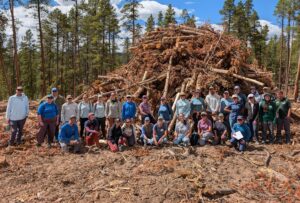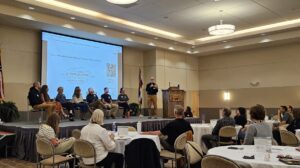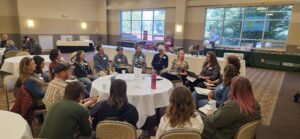
Over the summer, Julia Lankisch and I facilitated an interactive session at the North American Congress for Conservation and Restoration (NACCR), during which we took a small group of amazing participants through a futuring process.
By this, I mean that we worked with our group of attendees to develop a vision of the future for the conservation field, building from individual visions to one shared by the group.
This work is important because right now there are powerful people who are engaged in futuring, but the world they are painting for all of us isn’t the one we want. By giving life to our own version of the future, we take back that power. Our visions can help us continue to move towards the tomorrow we want. This process can also help us heal our trauma and connect to one another, and it is no surprise that it is also becoming known for its ability to enhance collaborative work.
So, I want to share with you all, the vision for the future of conservation that we created at NACCR. Does this future resonate with you? What would you add? What would your future look like?
A Vision for Conservation’s Future
NACCR 2026
Synthesis of Feedback from Participants in Weaving Together Interactive Session
Written by Aireona B. Raschke and Julia Lankisch; edited by Lizzie King
Our vision of the future of the conservation field is a field for which the current system sees considerable changes that result in better outcomes for people and nature, and create an increase in connections among people and nature. This is accomplished through a heightened emphasis on collaboration, shared values, learning, and a shift in how we (as members of the conservation field) show up, and in turn, create a healthier emotional landscape.
We envision a truly collaborative future of conservation that is inclusive to a broad spectrum of values and to all identities. In this future, we have successfully communicated to people across disciplines, belief systems, and generations that humans are interconnected with the Earth, the Water, and the rights of all non-human Relatives to exist with integrity.
Specific systems changes that we described for our shared future were varied and play an essential role in describing what the coming world will look like. In the future, conservation will be a part of the reimagining of many of the underlying models of our current society, including structures of power and class. The field will play a more active role in helping other sectors make better decisions.
We will build access to conservation and scientific knowledge for positive changemaking within the spheres of technology, economics, and industry. Collaboration will become a common and essential element of conservation. This will lead to an appreciation of the many kinds of outcomes that can stem from our work. It will also play a role in our movement towards scientific knowledge being democratized. Our future will contain opportunities for everyone to have a voice in conservation via democratic processes, to nurture and be nurtured through mentorship, and to have sustainably managed organizations and protected areas.
There will be a shift away from hierarchical power structures within our field, leading to better equity, more horizontal organizations, and new kinds of teams. We are intentionally discerning lessons from past mistakes and reimagining our social systems to center community. We wish to empower reciprocal relationships, trust-building, and healing through storytelling, conversations full of curiosity, place-based experiences in nature, and creative expression.
The conservation field will also adjust its relationship to nature, increasingly emphasizing the oneness of humans and our environments, and creating a fertile ground for people to heal their relationships with one another and the Earth. Through these changes, our field will become a stronger voice for the Earth and elevate the responsibility of care for all lands, including those places that we currently consider “low value.” Ideas such as the “rights of nature” will become more common and pivotal to our work.
These big changes will be promoted by several key categories of activities. Collaboration, while also considered an outcome of systems change, is an action that will increase, not only to help make scientific knowledge more attainable, but to help create hope together, and to find solutions that provide multiple outcomes. We will cultivate hope and agency by continuously healing ourselves, our communities, and the land through Indigenous rematriation, collaborative conservation, and ecological restoration.
Our methods of sharing knowledge with one another will also play a role in these changes and be a result of them. This includes a fearless focus on understanding what has gone wrong, facing our failures, and trying to move forward with creativity, curiosity, and fresh eyes. It also requires a focus on ensuring that learning for the field is accessible to all. There will be a renewed emphasis on mentorship, through which people at all stages of their careers can find support, and support others. There will be a renewed emphasis on experiences as well, and learning through place-based experiences in particular.
Likewise, how we as conservation professionals show up and represent our values will be both a force for change and a change itself. We will be willing to speak truth to power and represent our shared values. These will include inclusivity, trust, community, intentionality, creativity, equality, and a responsibility to care. We will show up as focused, curious, and we will also carefully listen. We will build trust among ourselves and other communities, and we will use art as well as writing to communicate who we are and why we do what we do. We will see with fresh eyes, and equipped thus, we will bravely move from conversation to action as genuine and authentic representations of ourselves, unafraid of failure.
All of this will create a new emotional landscape for our field, which will sustain us. This will be a space of hope, curiosity, shared empathy, and a sense of wonder. There will also be a trust in our communities and a trust in the environment itself.
Linked to all of this, there will be a resounding cultivation of connection across the field. This will include deepening connections to places, lands, waters, and to each other. There will be a strengthening of our understanding for and honoring of the deep and healing connections between people and nature itself, and interweaving of human and non-human communities. Within ourselves, as members of the conservation field, we will carry and be sustained by the importance of the responsibility that we have to our non-human relatives. Our work will also result in connections across and among habitats, land tenures, and communities.
All of this will be seen in the world around us. We will be sustained by our field, which will care more deeply for us and create spaces where we can care for ourselves and others. And, in turn, we will sustain our world, creating a future where nature can once more be a part of human communities, and where all people can feel connected to and responsible for the care of the planet that gives us life.