In this summary…
Page 1: Introduction and Wednesday Activities
- Our theme: What does “Collabor-Action” mean?
- Wednesday, September 9th
- Training: Taking Action with the Forest Resilience Planning Guide
- Avista Fire Resilience Challenge
- Welcome Social
Page 2: Thursday Summit: Morning sessions
- Land Acknowledgement & agenda roadmap
- Colorado Cafe: Table discussions & case studies that align with the 30-Year Vision for Forest Health in Colorado
Page 3: Thursday Summit: Afternoon sessions (you are here!)
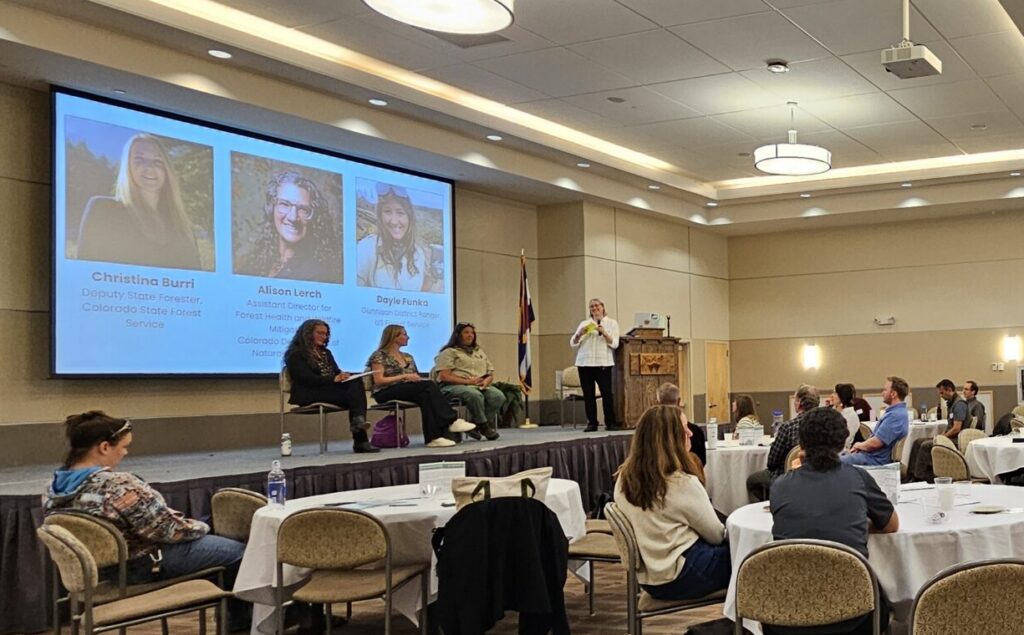
From Planning to Action: Understanding Collaborative Readiness Through the Upper Gunnison Shared Stewardship Council
Featuring an introduction from Ch’aska Huayhuaca and Laura Danz (Colorado Forest Restoration Institute)
Facilitated by Brett Wolk (Colorado Forest Restoration Institute)
Panelists:
- Lisa Bickford, Emergency Management Director, Gunnison Office of Emergency Management
- Sonja Chavez, General Manager, Upper Gunnison River Water Conservancy District
- Jarod Dunn, Socio-Economic Analyst, Colorado Forest Restoration Institute
- Briget Eastep, Director, Center for Public Lands, Western Colorado University
- Scott Morrill, Chief Operations Officer, West Region Wildfire Council
- Tim Pinnow, Executive Director, West Region Wildfire Council
- Gretchen Rank, Wildfire Resilience Manager, Colorado River Sustainability Campaign
Section summary written by Ch’aska Huayhuaca
The Upper Gunnison Shared Stewardship Council (UGSSC) offered a valuable case study in how cross-boundary collaboration can evolve from a shared concern into a foundation for landscape-scale action.
Catalyzed by the 2020 wildfire season and local forest health challenges, UGSSC began as an informal group of organizations seeking to get ahead of complex, interconnected problems. Partners worked together to develop a locally grounded Community Wildfire Protection Plan (CWPP) that reflects diverse land management priorities, community values, and the broader health and resilience of forests and watersheds. The plan was completed in spring 2025, and it marked an important transition from planning toward implementation.
Panelists highlighted how collaborative readiness develops through relationships, shared priorities, and the capacity to turn plans into action. The discussion also underscored that collaboration must evolve as needs change: from building a shared vision and developing strategy to coordinating implementation, tracking progress, and sustaining momentum.
Following the panel, participants connected these lessons to their own experiences in a summit-wide polling activity. In that activity, the most frequently identified conditions supporting the transition from planning to implementation were having a champion who can bring together a strong team, strong relationships, sufficient capacity, early wins, and facilitation. Community support, willing partners, and clear roles also featured prominently. When asked what a collaborative needs to implement at scale, participants most often selected a coordinator to sustain communication and convening, followed by clear partner roles and shared tools for tracking and communicating progress.
Together, these reflections reinforce that a plan is an important milestone, but implementation depends on the relationships, leadership, coordination, and capacity that enable partners to act collectively. Collaborative readiness is not a box to check; it is an ongoing process of building and adapting the conditions needed to achieve shared outcomes.
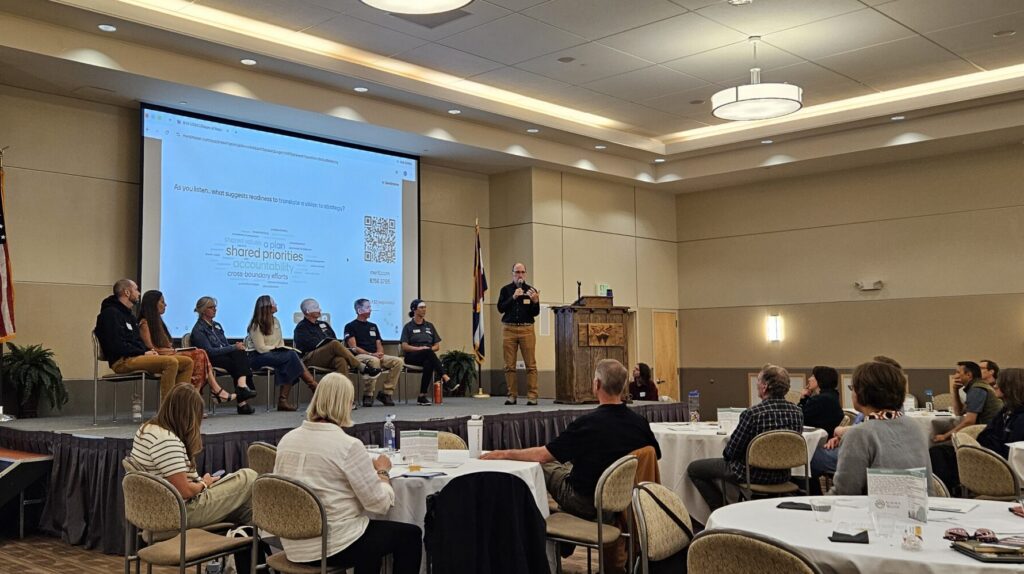
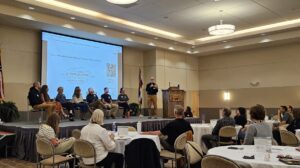
Leadership Panel
Our leadership panel was facilitated by Audrey Miles Cherney, the Coordinator of the Upper South Platte Partnership. During our Colorado Cafe earlier in the day, we asked participants to submit questions for leadership as they arose in the table discussions. Audrey reviewed the submissions and crafted panel questions from them. The first two panel questions below were written ahead of Summit; the remaining questions were prepared day-of in response to real-time conversations.
Our panelists were:
- Christina Burri, Deputy State Forester, Colorado State Forest Service (CSFS)
- Alison Lerch, Assistant Director for Forest Health and Wildfire Mitigation, Colorado Department of Natural Resources (DNR)
- Dayle Funka, Gunnison District Ranger, Grand Mesa, Uncompahgre and Gunnison National Forests, US Forest Service (USFS)
Q1: What updates do collaboratives need to know about your agency looking forward to 2027?
Christina Burri (CSFS):
- As of July 1st, CSFS transitioned out of Warner College of Natural Resources and into the Office of Engagement and Extension. This should not impact on-the-ground staff, partnerships, or internship opportunities, but offers benefits to CSFS as an organization including:
- Opportunity for CSFS to better align with the land grant mission at Colorado State University.
- A more direct line of connection to University leadership.
- Construction on the new CSFS nursery is nearly complete; just waiting on some concrete work. A formal grand opening of the nursery will happen in October at the CSFS annual meeting. The nursery presents an opportunity to think about a holistic reforestation strategy.
Alison Lerch (DNR):
- It’s an election year – transitions are coming within the Governor’s office and possibly within the DNR. We won’t know exactly what this looks like until after the election.
- Colorado Water Conservation Board has expanded their Wildfire Ready Watershed and Wildfire Ready Action plan footprints across the state. The Colorado Water Plan Grant offers 2 application periods per year. The next cycle of funding closes December 1st.
- The Colorado Strategic Wildfire Action Program (COSWAP), recently released their five-year impact report. The program has impacted 30 counties and 140+ projects.
- The Ponderosa Mountain Pine Beetle Task Force is expected to continue through the end of 2027. At the time of Summit, they were in the process of creating recommendations (draft recommendations from September 2026 are now available here; at the time of writing this summary these have not yet been finalized or approved).
- At the time of Summit, the Drought Task Force had just shared a memo with the governor’s office recommending the state advance to Phase 3 of the Drought Response Plan.
Dayle Funka (USFS):
- The USFS has been going through an organizational restructure. USFS was originally formed on watersheds and had 9 regions in the nation. They are now moving toward a state model; details are currently being worked out in high levels of USFS management. There will still be forest supervisor offices and ranger districts.
- There is a need to strengthen relationships with collaboratives through this transition. As higher-level changes continue to shape local work, it will be important to communicate.
Q2: Tell us about how your agency is taking action towards the Colorado Forest Health Council’s 30-year vision, and what do you need from those of us in the room to get there?
Christina Burri (CSFS):
CSFS is doing lots toward the 30-Year Vision. A few examples of how CSFS staff improve landscapes, tell the story of forest management, and use science to inform decision making:
- 18 boots-on-the-ground field offices proactively manage forests and fight fires.
- GIS staff are tracking accomplishments, linking project data into bigger picture efforts like the Forest Tracker, and using data to tell the story of forest management.
- Forest health staff are doing aerial surveys to help understand the health of the forest.
- Program staff are working on biomass utilization, watershed program, Good Neighbor Authority program, and more.
What CSFS needs from folks attending Summit: Make sure that the challenges you face are communicated to decision-makers. One example is affordable housing. This is one of the root causes of workforce issues, yet may not be top of mind for a landowner focused on the impact of MPB on their favorite tree. It’s powerful for practitioners to provide input on the challenges they face. The folks on this leadership panel can be a conduit to share feedback.
Alison Lerch (DNR):
Much of DNR’s portfolio aligns with the 30-Year Vision, especially the Mindset and Culture Shift section. DNR’s mission is to manage and conserve Colorado’s natural resources for the benefit of people today and tomorrow. This includes balancing development, conservation, recreation, and more.
- One example of alignment/collaboration within DNR divisions: Colorado Water Conservation Board published a technical memo incorporating forest health considerations and projections for the Colorado Water Plan.
- The first convening of the Mountain Pine Beetle Task Force was guided by the 30-Year Vision. Members were asked, how can this Task Force help make sure that the work of this Task Force will align with the Vision?.
- COSWAP works with Conservation Youth Corps and the Department of Corrections Swift Crews. How can we continue to boost up our young and youth workforce to stay in the state to do conservation work?
- DNR, CSFS, and the Division of Fire Prevention and Control are coordinating to ensure that investments are strategic and focused.
Words of inspiration: We need everyone to continue contributing to the 30-Year Vision. A tough drought and wildfire year causes stress on forests and watersheds, and also on us. Take a step back when tasks feel impossible. Lean into your partners. We have a lot of really good plans. It can be a little overwhelming, but they are a guide when you feel stuck. We’re all in this together.
Dayle Funka (USFS):
The USFS and the Gunnison Ranger District are in alignment with the 30-Year Vision through active forest management: timber operations, fuels reduction, watershed health, recreation management.
- Challenges: Workforce housing, cost of living, and pipeline issues. Folks aren’t going into this line of work anymore. You’re not going to get rich working for a land management agency. How do we create conditions so Western Colorado University students can stay in Gunnison?
- The Gunnison Ranger District has done a lot of timber production in past years, but the ‘low hanging fruit areas’ have been logged. Things don’t grow in Colorado like they do in Oregon. Need for forest products industry, not just recreation tourism industry. We need a diverse industry.
- One of the biggest needs is educating the local community to create a pipeline of young, innovative, tenacious workforce.
Q3, an audience submission: Is it realistic to manage mountain pine beetle at a landscape scale? Are there any recommendations coming out of the MPB Task Force that might be relevant to this kind of concern?
Christina Burri (CSFS):
- One of the MPB discussion groups in the Colorado Cafe talked about what transition looks like after the pine beetle occurs and what those opportunities look like. It was a hopeful discussion.
- There is a scenario where proactive management ahead of a mountain pine beetle outbreak can be successful. There are also scenarios where the outbreak happens and then we manage for recovery. There are many different scenarios; in any case, we all work together on managing threats before, during, and after.
At the time of Summit, the MPB Task Force had not yet released any recommendations. Instead, Christina pointed attendees to the MPB Task Force webpage and noted that each meeting has an opportunity for public comment.
Since Summit, the MPB Task Force released draft recommendations. At time of writing, these are under review, but are expected to be finalized and voted on by the end of the year.
Alison Lerch (DNR):
The local engagement and public communications working group is having powerful conversations about this. Though the question is about landscape scale management, the outbreak is on a checkerboard landscape including a lot of private land. The Task Force is producing information for private landowners about how to deal with this problem immediately and in the future.
Q4: Public support and perception are key to funding and social license. People doing work on the ground (such as contractors and entry-level hand crews), often interact with members of the public that come across their work. We have some resources out there as a state – such as the new Mitigation Success Stories Hub, the Forest Trends Protect What Matters Campaign, or the Live Wildfire Ready campaign. What other resources are you aware of or that may help provide consistent messaging – including resources for folks doing the work on the ground, and recognizing that there are different types of audiences with different needs?
Alison Lerch (DNR):
No matter what level you’re at, communication ultimately comes down to diving into the values that we’re trying to protect through forest management. Colorado Water Conservation Board’s Statewide Post-Wildfire Susceptibility Analysis is a great resource to dive into why we do things for water. Messages about water tend to be really powerful.
Christina Burri (CSFS):
The Colorado Forest Action Plan five-year review captured many success stories since 2020; it’s a great tool and resource.
Dayle Funka (USFS):
As an Agency Administrator on wildfires, Dayle does briefings every morning. She answers lots of questions: What are our objectives? What are our values at risk? What are the threats to firefighter safety? What wildfire fighting strategy are we using today? Ultimately, these questions all boil down to one thing: WHY? Why did we make that choice? What are we protecting? Why does it matter?
In communication, always lead with why you made that decision, why it matters. Examples of why we do forest management often include improving water quality/quantity, creating conditions for fire to move through the forest in a healthy way, or creating safe ingress and egress routes for wildland firefighters. Visuals can also help – take folks to managed parts of the forest and talk through what they see.
Q5, an audience submission. “State programs like COSWAP and program are grant programs many of us are familiar with, and they do a good job of encouraging projects to address multiple concerns. However, many of the co-benefits of wildfire risk reduction projects usually get lumped under forest health. Should these programs explicitly include climate change adaptation as a program goal? And if so, what does that look like and how does climate adaptation get balanced with wildfire risk reduction?”
Christina Burri (CSFS):
Adaptive silviculture is a priority for the CSFS Science and Data Division, when training new foresters, and as part of Colorado State University. CSFS has a few specific projects focusing on adaptive silviculture for climate resilience, researching treatment types, and understanding water benefits.
Alison Lerch (DNR):
Can COSWAP think about incorporating climate adaptation? Yes. The “Looking Ahead” section of the 5-year impact report explores how COSWAP can get better and adapt. Colorado Forest Restoration Institute is doing monitoring on our COSWAP programs to make sure that the program is adapting to emerging needs.
Q6: One of the Colorado Cafe table discussions focused on forest carbon. An idea that arose was the concept of hosting a Colorado Carbon Collaborative. Is that something you envision the state could support? What are your initial thoughts and reactions to this idea?
Christina Burri (CSFS):
Yes. CSFS and DNR are doing a lot of work in this arena. The concept is good.
Dayle Funka (USFS):
In Taylor Park, the Adaptive Silviculture for Climate Change (ASCC) (note: this was a Summit field trip destination) Trail Creek timber sale is ongoing. One goal was to do something other than burning piles, such as biochar. There is a lot of momentum and innovation behind that. There is still a long way to get to a large-scale operation. But it would be really cool to do something different with the piles.
Continue reading…
Page 3: Thursday Summit Afternoon Session